How to use a test bar to measure clay shrinkage
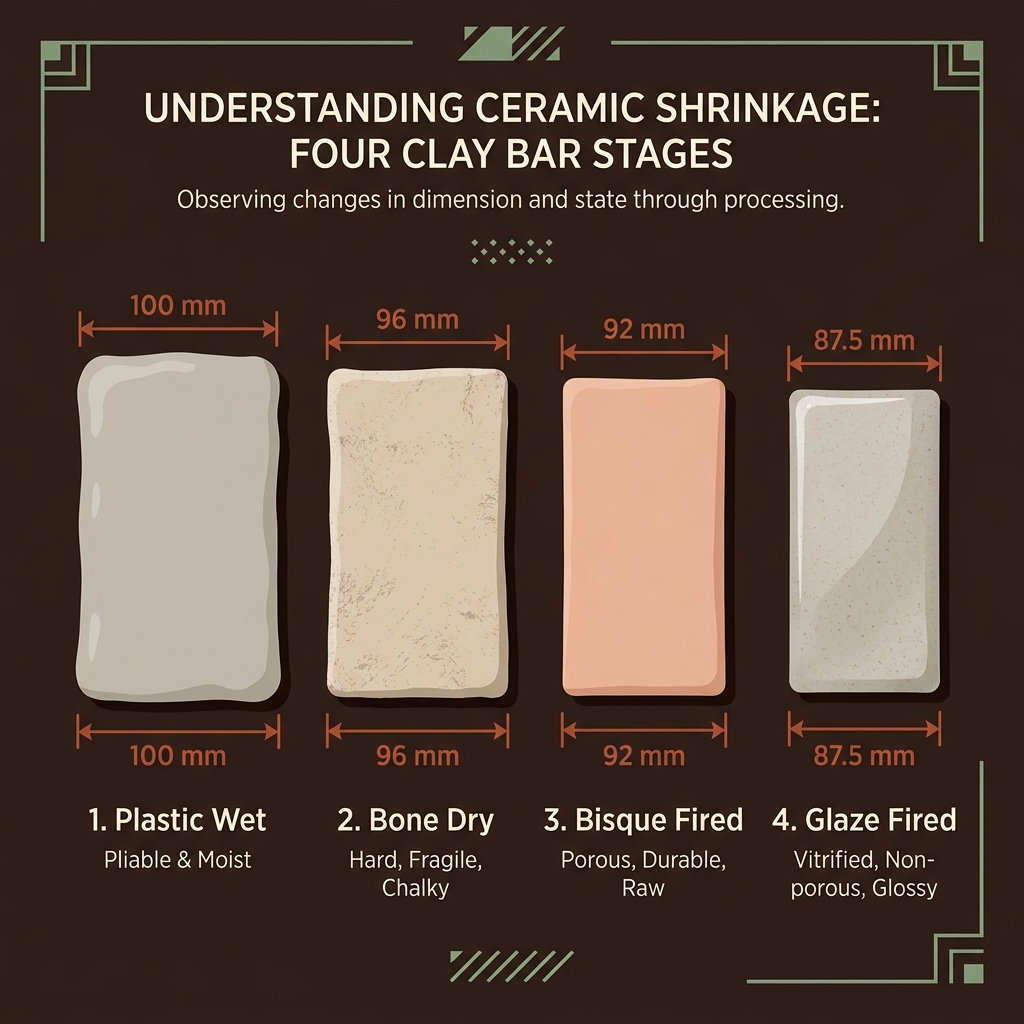
- Roll or press a consistent clay strip. Make it 150–200 mm long for accuracy.
- Mark two reference points exactly 100 mm apart while the clay is plastic.
- Record the wet measurement (100 mm, or whatever span you used).
- Dry the bar. Measure the span after bone-dry to get drying shrinkage.
- Bisque fire and measure again if you want staged data.
- Glaze fire to your final temperature and schedule. Measure the fired span.
Total shrinkage % = 100 × (1 − fired length ÷ wet length)
Worked example
Wet span: 100 mm. Bone-dry: 96 mm. Bisque: 92 mm. Final fired: 87.5 mm.
- Wet → dry shrinkage: 100 × (1 − 96/100) = 4.0%
- Dry → bisque: 100 × (1 − 92/96) ≈ 4.17%
- Bisque → final: 100 × (1 − 87.5/92) ≈ 4.35%
- Total wet-to-fired: 100 × (1 − 87.5/100) = 12.5%
Measurement cautions
- Measure between your reference marks, not the bar ends — the ends are rough and unreliable.
- Cool the fired bar completely before measuring.
- Use calipers if possible; a steel rule introduces more error.
- Run at least two or three bars from the same batch for repeatability.
Why staged shrinkage matters
Knowing the drying and bisque stages separately helps you plan slow-drying schedules for large pieces, anticipate stress cracking risk, and understand why two clays with the same total shrinkage may behave differently in a multi-stage firing routine.