How lid fitting calculations work
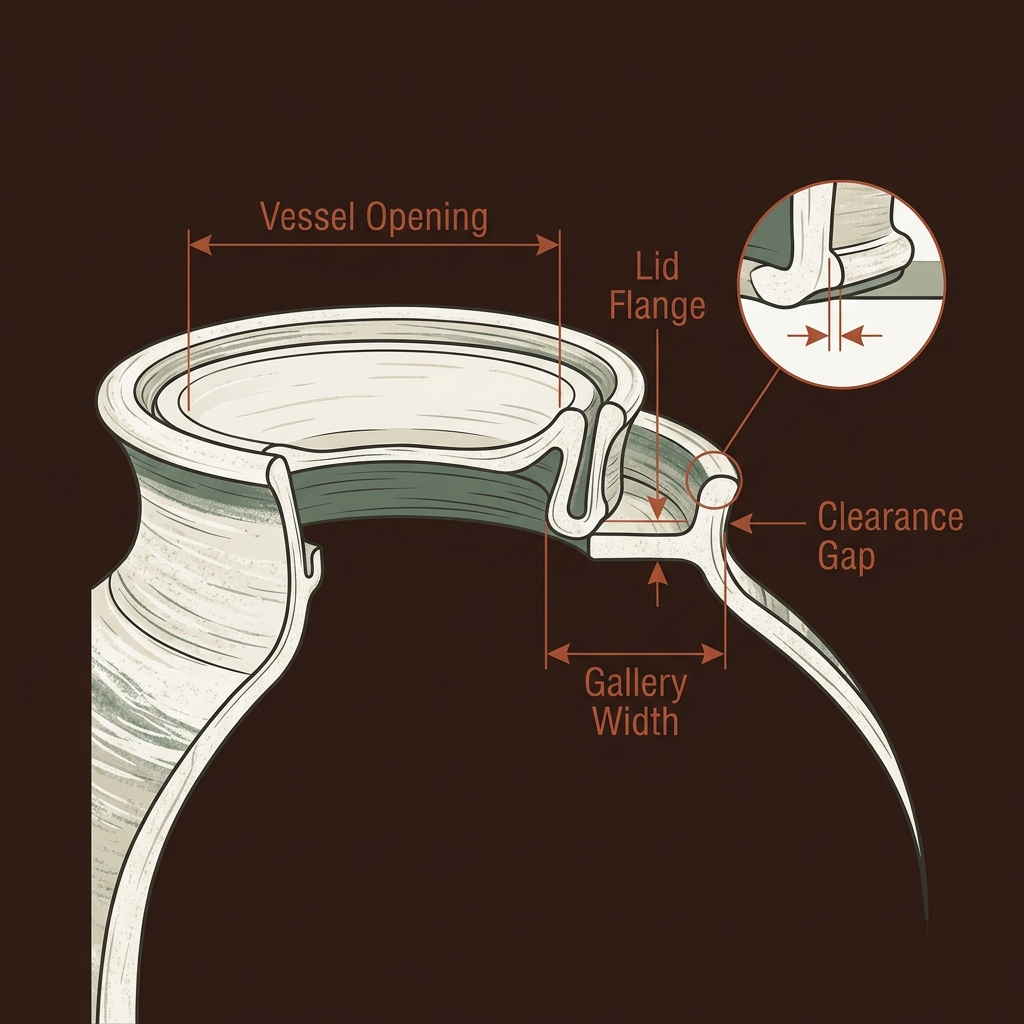
Clay shrinks during drying and firing. If you throw a lid to match the opening of a vessel, both will shrink — but unless the lid and vessel shrink by the same amount to the same fired dimensions, the fit will be wrong.
The correct approach is to define the desired fired dimensions first, then work backward to the wet dimensions using the shrinkage expansion factor:
Lid types and clearance
The clearance you specify is the fired gap between the lid and the vessel wall on each side:
- Drop-in lid: Lid sits inside the opening. A clearance of 0.5–2 mm fired is typical.
- Overlapping lid: Lid flange extends over the rim. Clearance is the firing gap at the shoulder contact.
- Gallery lid: Lid rests on an inner shoulder thrown into the vessel wall. The gallery is thrown to a specific inner diameter.
- Stopper: A plug that fits into a narrow neck opening, like a bottle stopper.
Important limitations
These calculations use your shrinkage rate uniformly across all dimensions. Real-world factors that affect lid fit include:
- Glaze thickness — glaze can narrow an opening or add bulk to a lid by 0.3–1 mm per side
- Warping during firing, particularly in thin-walled pieces or when kiln temperature is uneven
- Rim deformation during throwing or trimming
- Variation within a single batch of clay
Always throw a test pair before producing a set of lidded pieces, especially for production quantities or tight-fitting lids.
Worked example
You want a drop-in lid for a jar with a 100 mm fired opening. Your clay shrinks 12.5%. You want 1 mm clearance on each side (2 mm total).
Fired lid diameter = 100 − (2 × 1) = 98 mm. Expansion factor = 1 ÷ (1 − 0.125) = 1.1429.
Wet vessel opening = 100 × 1.1429 ≈ 114.3 mm