What is anisotropic clay shrinkage?
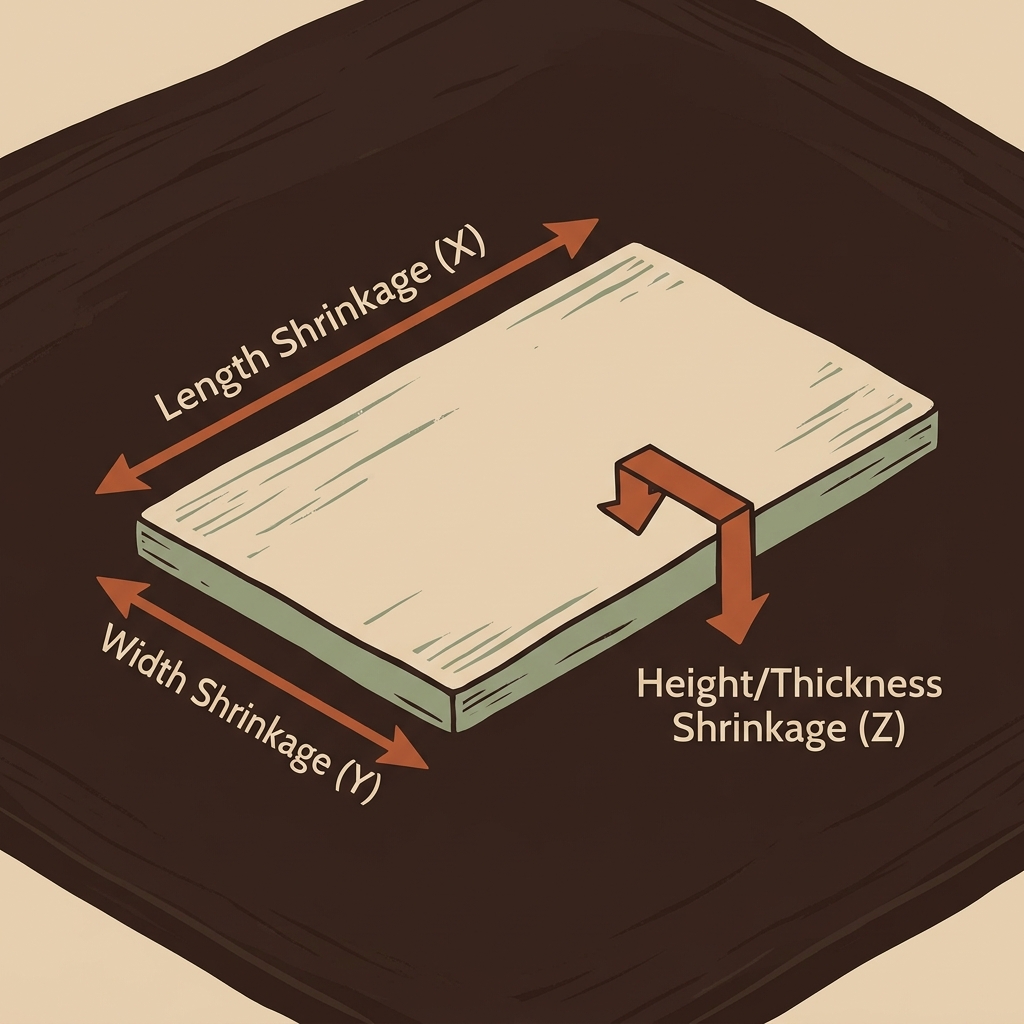
Anisotropic shrinkage occurs when a clay body does not shrink by the same percentage in all directions. This is common in:
- Extruded forms — clay particles align along the extrusion direction, causing differential shrinkage along and across the extrusion axis
- Rolled slabs — rolling creates directional particle alignment
- Compressed clay — hand-pressing or ram-pressing can compress particles in one plane
- Thrown forms — radial and vertical shrinkage may differ slightly
- Tile making — length and width shrinkage may differ from thickness shrinkage
How to measure directional shrinkage
Run separate test bars oriented along each axis you need to measure. A slab tile, for example, requires bars cut parallel to the length and separately cut parallel to the width. Mark each bar with 100 mm reference spans and fire alongside your work.
Wet width = desired fired width ÷ (1 − width shrinkage%)
Wet height = desired fired height ÷ (1 − height shrinkage%)
Limitations
Directional shrinkage values must be measured from your actual clay body under your forming and firing conditions. This tool does not provide generic anisotropic presets — these vary too widely between clay formulations and production methods to be presented as reliable defaults.
Other factors that can affect directional results include firing support, slab compression, grain alignment introduced by reclaim processing, and the position of pieces in the kiln.
Comparison with uniform shrinkage
The calculator also shows the deviation between each axis-specific wet dimension and what a uniform-shrinkage calculation would have produced. Small deviations (under 1 mm for typical tile sizes) may not matter in practice. Larger deviations — particularly in length for large tiles — can accumulate into visible misalignment in a gridded installation.